
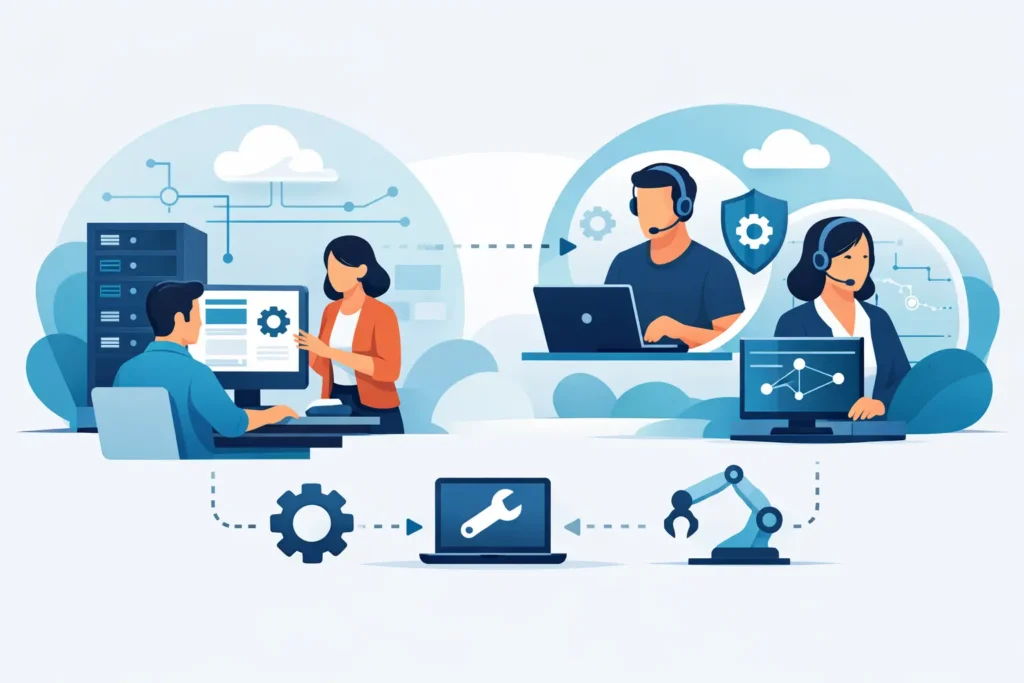
Outsourcing IT usually fails for one of two reasons: the business hands off too little and gets no relief, or it hands off too much to the wrong provider and loses control. If you are deciding how to outsource IT operations, the real question is not whether another company can answer tickets or monitor systems. It is whether they can protect continuity, reduce risk, and take accountable ownership of systems your business cannot afford to have fail.
For small and mid-sized organizations, that distinction matters. A law firm, clinic, manufacturer, municipality, or financial office does not need more vendor sprawl. It needs one disciplined operating model for infrastructure, end-user support, cybersecurity, compliance, and recovery. Outsourcing works when it replaces fragmentation with accountability.
What outsourcing IT operations should actually mean
Many companies treat IT outsourcing as help desk coverage. That is too narrow. IT operations include the daily management, monitoring, maintenance, protection, and improvement of the systems your staff depend on. That can include servers, endpoints, cloud environments, backups, access controls, patching, procurement, vendor coordination, cybersecurity monitoring, and strategic planning.
If a provider only takes the noisy tasks while your internal team still carries the operational risk, you have not really outsourced IT operations. You have only redistributed labor. A stronger model shifts responsibility for outcomes such as uptime, security oversight, escalation discipline, documentation, and incident response.
That does not mean giving up control. It means setting clear governance so the provider runs operations within standards your business approves.
How to outsource IT operations without creating new risk
The safest path starts with scope, not sales. Before you evaluate any partner, define what you need managed, what must remain internal, and what outcomes matter most. For some organizations, the main pressure is after-hours support and infrastructure maintenance. For others, it is compliance readiness, ransomware defense, or replacing a patchwork of hosting, security, and support vendors.
Start by separating business-critical functions from optional ones. Core operations usually include user support, device management, server administration, network oversight, backup verification, identity and access management, security monitoring, and incident handling. Strategic ownership, budget authority, and policy approval often stay internal, even when execution is outsourced.
This is where many leaders make a costly mistake. They ask, “What can this provider do?” before asking, “What must this provider be accountable for?” A capable vendor can offer many services. A reliable managed partner accepts measured responsibility.
Define the operating model first
A clear operating model sets expectations early. Decide who owns approvals, who can make changes, how escalations are handled, what reporting is required, and what happens during a security event. If your business operates in a regulated environment, include documentation standards, audit support expectations, access logging, and data handling rules from the beginning.
This is also the stage to decide where your systems and data should reside. For many organizations, especially those with compliance obligations or sovereignty requirements, infrastructure location is not a technical footnote. It is a governance decision.
Choose a partner built for security, not just support
If you are outsourcing operations, you are extending trust into your environment. That makes security maturity non-negotiable. Look beyond ticket response promises and ask how the provider manages privileged access, endpoint protection, log monitoring, backup integrity, patching discipline, phishing response, and incident escalation.
A provider managing your infrastructure should be able to explain how security is embedded into daily operations, not sold as a separate afterthought. Audited controls, documented processes, continuous monitoring, and a clear chain of accountability matter more than broad claims.
For organizations with compliance pressure, independent assurance also matters. Certifications and verified controls do not replace due diligence, but they do show operational discipline.
What to evaluate before signing anything
The right provider should reduce operational burden while increasing visibility. If they cannot show you how they work, reporting will likely be reactive and accountability will stay vague.
Start with support structure. Ask whether you will have a dedicated team, how after-hours issues are handled, and what escalation paths look like. General availability is not enough. You need to know who owns the environment and how quickly the provider can move from alert to action.
Then examine tooling and integration. If the provider relies on a patchwork of disconnected platforms, your experience may become fragmented as well. Strong IT operations are coordinated across support, cybersecurity, asset management, monitoring, and documentation. When those functions are unified, issues are resolved faster and root causes are easier to track.
Documentation is another revealing test. Mature providers document environments, changes, assets, dependencies, and recovery procedures as part of the service. If documentation is sparse or treated as optional, continuity risk rises immediately.
Finally, ask how they handle transition. Good providers do not rush onboarding. They assess your environment, identify risks, validate backups, map dependencies, and build a phased plan. A messy handoff usually signals messy operations later.
Common outsourcing mistakes that cost more later
The first mistake is outsourcing only for cost relief. Cost matters, but IT operations affect revenue continuity, legal exposure, customer trust, and staff productivity. A cheaper arrangement that weakens visibility or security often becomes more expensive when an outage, breach, or failed audit occurs.
The second mistake is keeping too many split responsibilities. If one company handles support, another handles security, another hosts critical systems, and nobody owns the full outcome, incident response slows down fast. During a disruption, every gap in ownership becomes visible.
The third mistake is ignoring internal readiness. Even when operations are outsourced, your business still needs executive ownership, an internal point of contact, and clear policies. A provider can enforce standards, but it cannot replace leadership decisions around acceptable risk, compliance posture, and business priorities.
When a co-managed model makes more sense
Not every business should fully outsource. If you have internal IT leadership or specialized application owners, a co-managed approach can be the better fit. In that model, your internal team keeps strategic control or application knowledge while the managed provider takes on monitoring, security operations, infrastructure administration, user support, and overflow capacity.
This works especially well for growing organizations whose internal IT staff are stretched thin. Instead of asking a small team to cover projects, support, cybersecurity, procurement, and after-hours incidents, co-management gives them operational backup and stronger process depth.
The key is role clarity. Co-managed environments fail when both sides assume the other is handling a task. They succeed when ownership is documented and reviewed regularly.
How to measure whether outsourced IT operations are working
Do not judge success by ticket volume alone. Better IT operations should show up in fewer recurring incidents, faster containment of problems, cleaner audits, stronger backup confidence, and less executive time spent chasing vendors.
Look at operational indicators such as patching compliance, backup verification, mean time to respond, mean time to resolve, endpoint health, account security posture, and change control discipline. Then connect those metrics to business outcomes: uptime, staff productivity, risk reduction, and readiness for audits or cyber events.
You should also expect regular strategic review, not just reactive reporting. A managed provider should identify recurring weaknesses, recommend improvements, and help align technology decisions with business needs. That is where outsourced operations become more than a support function. They become an operational safeguard.
The standard to hold your provider to
If you want to know how to outsource IT operations wisely, hold every option to a simple standard: can this partner take accountable ownership of daily technology operations while improving security, visibility, and resilience?
That standard rules out a surprising number of providers. Some can answer tickets. Some can maintain infrastructure. Far fewer can do those things while supporting compliance, protecting critical data, coordinating across hosting and security, and giving leadership confidence that the environment is under control.
The right managed partner should make your technology estate feel less exposed, less fragmented, and less dependent on chance. That is the real value. Not just outsourced labor, but verified operational discipline.
Aegisys Cloud Solutions is built around that model. Security-first management, accountable support, and protected infrastructure are not side offerings. They are the operating baseline your business should expect.
When you choose to outsource, choose a structure that makes your business stronger under pressure, not just lighter on paper.