
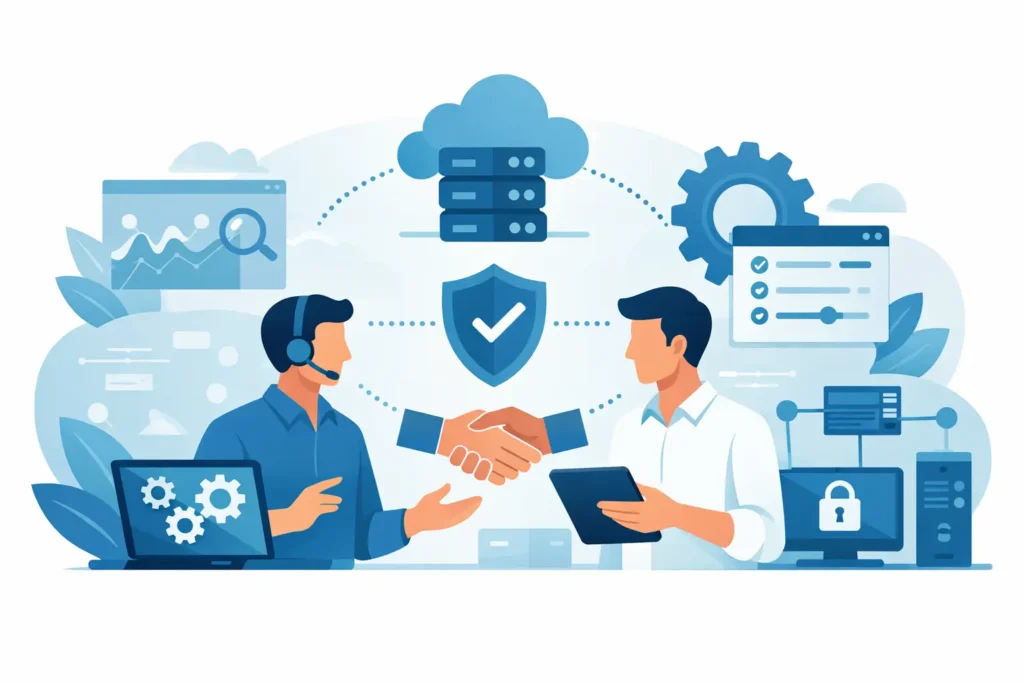
Most internal IT teams do not need to be replaced. They need backup, depth, and coverage. That is the real answer to what is co managed it services: a shared operating model where your internal IT staff and an external managed services provider work together under clearly defined responsibilities.
For growing businesses, that arrangement solves a common problem. The internal team understands the business, users, systems, and politics. The outside partner brings specialized tools, 24/7 monitoring, cybersecurity discipline, escalation support, and broader operational experience. When it is structured properly, co-managed IT is not a handoff. It is a controlled partnership.
What is co managed IT services in practical terms?
Co-managed IT services is a support model in which an organization keeps its internal IT function but augments it with a managed IT provider. Instead of outsourcing everything, the business shares responsibilities with a partner based on gaps in staffing, expertise, time, security maturity, or coverage.
That division can look different from one organization to another. In one environment, the internal team may own end-user support, hardware deployment, and business application administration, while the provider handles cybersecurity monitoring, patch management, backup oversight, and after-hours response. In another, the provider may take on help desk overflow, cloud administration, vendor coordination, and strategic guidance while the internal IT manager remains the primary point of accountability inside the business.
The key idea is simple: your team stays in control, but it no longer has to carry every technical and security burden alone.
Why businesses choose co-managed IT services
This model usually appears when a company has outgrown a lean internal IT setup but is not ready, or does not need, to build a large in-house department. That is especially true in regulated or operationally sensitive environments where uptime, audit readiness, and security controls matter every day.
An internal IT generalist can be highly capable and still be stretched too thin. One person may be handling user issues, Microsoft 365 administration, vendor calls, endpoint problems, onboarding, backups, and cybersecurity alerts. That is not a sustainable risk model. Co-managed IT services adds capacity and specialization without forcing the organization to dismantle what is already working.
It also helps businesses move from reactive support to managed operations. Instead of waiting for a server issue, security event, or failed backup to become visible, the provider introduces monitoring, escalation paths, documentation discipline, and accountability. For leadership teams, that shift matters because it changes IT from a source of uncertainty into a controlled business function.
What co-managed IT includes and what stays internal
The best co-managed relationships are defined by role clarity. If both sides assume the other is handling a task, gaps appear fast. Those gaps often show up in patching, MFA enforcement, backup verification, after-hours alerts, and incident response.
A mature co-managed arrangement often includes several shared layers of responsibility. The external provider may handle infrastructure monitoring, endpoint protection, security operations, patching, backup oversight, cloud support, documentation, procurement guidance, and escalation for complex issues. The internal team may retain ownership of user relationships, department-specific applications, executive support, local process knowledge, and final business decisions.
This is where co-managed IT becomes stronger than either model alone. Internal IT knows what matters most to the business. The provider contributes process maturity, security controls, and specialized resources that are difficult to maintain with a small team.
What is co managed IT services not?
It is not a quiet takeover of your IT department. It is not a generic help desk layered on top of your staff. And it is not effective if the provider treats your internal team like an obstacle instead of a partner.
A weak co-managed model creates tension. Internal IT feels second-guessed, leadership gets mixed messages, and no one is certain who owns risk. A strong model does the opposite. It respects internal expertise, reinforces accountability, and makes escalation faster instead of more political.
That distinction matters. Businesses in healthcare, legal, finance, education, government, and other high-trust sectors cannot afford blurred ownership. If a ransomware incident, outage, or audit issue happens, there must be no confusion about who saw what, who acted, and who is accountable.
The security advantage of co-managed IT
For many organizations, security is the main reason to adopt this model. Internal IT teams are often expected to manage both operations and defense, but those are not the same discipline. Keeping systems running is one job. Watching for threats, enforcing controls, responding to alerts, and maintaining visibility across endpoints, identities, and cloud systems is another.
Co-managed IT services closes that gap by giving the business access to dedicated operational and security capabilities without forcing one internal person to do everything. That can include monitored endpoint protection, managed detection and response, vulnerability management, log visibility, backup oversight, policy support, and after-hours escalation.
There is still a trade-off. Security improves only when responsibilities are explicit and the provider has real authority to act within the agreed scope. If the provider can see threats but not isolate devices, enforce standards, or escalate effectively, the model looks stronger on paper than it is in practice.
For compliance-conscious organizations, this is where provider maturity matters. Certifications, documented processes, audited controls, data handling discipline, and around-the-clock monitoring are not marketing extras. They are evidence that the provider can operate in environments where trust must be earned and verified.
When co-managed IT makes sense
Co-managed IT is usually the right fit when the business already has someone internal who should remain involved, but that person or team needs support. That may be due to growth, increasing security requirements, limited after-hours coverage, cloud complexity, project backlog, or pressure from compliance and cyber insurance standards.
It is often a strong fit for businesses with 25 to 500 users, especially when technology has become essential to operations but internal IT headcount has not kept pace. It also makes sense when leadership wants better reporting, more structured risk management, and a clear path for strategic planning without depending on a single individual.
It may be less effective if the organization wants to delegate everything but still resists standardization. Co-managed IT depends on shared process. If internal stakeholders refuse security policies, reject documentation, or bypass support channels, the model becomes harder to govern.
How to evaluate a co-managed IT partner
The right provider should be able to explain exactly how responsibilities will be divided, how communication works, what gets monitored, how incidents are escalated, and how security controls are enforced. If those answers are vague, the service will be vague too.
Look for operational discipline, not just technical claims. That includes documented onboarding, role-based access control, reporting, security stack visibility, service boundaries, escalation paths, and business reviews that tie technology work back to risk and continuity. In regulated environments, audit posture and data sovereignty may also be essential.
Just as important, the provider must be able to work with internal IT respectfully. Co-managed services fails when ego gets involved. Your internal team should feel stronger, not displaced. A capable provider knows when to lead, when to support, and when to advise.
For organizations that value security-first IT management, this model can be especially effective when the provider can integrate managed IT, cybersecurity operations, hosting, advisory support, and infrastructure accountability under one governed relationship. That kind of structure reduces handoff risk and makes accountability easier to maintain.
What success looks like
When co-managed IT services is working, support becomes more predictable, security gaps shrink, projects move faster, and internal IT has room to focus on higher-value work. Leadership gains better visibility into operational risk. Users get more responsive support. Critical systems are monitored with more consistency. The business is less dependent on one person carrying too much institutional and technical responsibility.
That does not mean every challenge disappears. Shared models require communication, governance, and periodic adjustment. Responsibilities evolve as the business changes. New systems are added. Risk priorities shift. Good co-managed IT is not static. It is actively managed.
The strongest outcome is not simply better ticket handling. It is better control. Your team retains business knowledge and internal ownership while the provider adds resilience, coverage, and specialized expertise that strengthens the whole environment.
If your internal IT team is capable but overextended, co-managed IT may be the most practical way to improve security and operational maturity without losing control. The best partnerships do not replace your people. They make your business harder to disrupt.