
A server goes down at 2:13 a.m. A phishing email lands in an employee inbox at 8:07 a.m. A compliance questionnaire arrives before lunch. For many businesses, those events trigger three different vendors, a lot of guesswork, and too much risk. That is exactly why people ask, what is managed IT services, and whether it is just outsourced helpdesk or something far more strategic.
Managed IT services is an ongoing partnership where a specialized provider takes responsibility for monitoring, maintaining, supporting, and securing some or all of a company’s technology environment for a predictable monthly fee. The key word is managed. This is not break-fix support that appears only after something fails. It is continuous oversight designed to prevent downtime, reduce security exposure, and give business leaders clear accountability.
For organizations with lean internal IT teams, limited in-house expertise, or rising compliance pressure, that shift matters. Instead of reacting to outages, expired backups, missed patches, and user issues one at a time, managed services puts those responsibilities under a structured operating model.
What is managed IT services in practice?
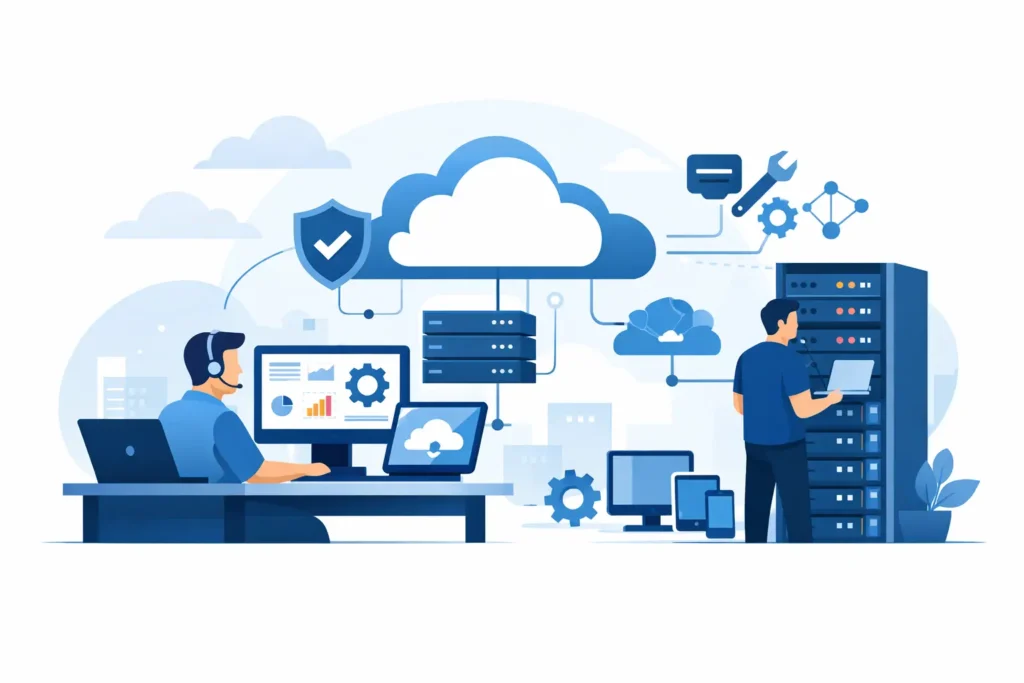
In practice, managed IT services means a third-party provider becomes responsible for agreed parts of your technology operations. That can include end-user support, infrastructure management, cloud administration, cybersecurity monitoring, backup oversight, Microsoft 365 management, vendor coordination, and strategic IT planning.
The scope depends on the business. A small company may need a provider to function as its full IT department. A larger or regulated organization may keep internal IT staff but rely on a managed services partner for 24/7 monitoring, security operations, compliance support, and specialized engineering.
That distinction is important because managed IT is not one fixed product. It is a service framework. The right model is shaped by risk profile, industry requirements, internal capability, and business hours. A law firm handling sensitive client records does not have the same operational needs as a manufacturer with multiple sites or a nonprofit trying to control costs.
How managed IT services differ from traditional IT support
Traditional IT support is usually reactive. Something breaks, a ticket is opened, and someone works to fix it. That approach can solve immediate problems, but it rarely addresses the underlying causes of instability or exposure.
Managed IT services is built around prevention and continuity. Systems are monitored continuously. Patches are applied on a schedule. Backups are checked. Security controls are tuned. Performance issues are reviewed before they become business interruptions. Support is still part of the service, but support is not the whole service.
There is also a financial difference. Break-fix work can look cheaper until a real incident happens. An outage, ransomware event, failed hardware refresh, or compliance gap can cost far more than a predictable monthly service agreement. Managed services does not eliminate every risk, but it puts controls and accountability around risks that too often go unmanaged.
What services are usually included?
A managed IT provider may offer a wide stack of services, but mature programs typically cover several core areas.
First is user and device support. That includes helpdesk assistance, workstation management, laptop configuration, mobile device policies, and onboarding or offboarding employees. This is the visible side of managed IT, and many buyers stop there. They should not.
Second is infrastructure management. Servers, firewalls, switches, wireless networks, cloud environments, storage systems, and line-of-business platforms all need maintenance and oversight. If those systems are central to operations, they need more than occasional attention.
Third is cybersecurity. This is now inseparable from managed IT. Security monitoring, endpoint protection, vulnerability management, phishing defense, identity controls, and incident response planning are no longer optional layers. They are part of responsible operations.
Fourth is backup and disaster recovery. A backup that has never been tested is a false sense of security. Managed IT services should include backup monitoring, recovery readiness, and a clear plan for restoring systems and data.
Fifth is strategic guidance. Strong providers do not just keep systems running. They help clients make better decisions about lifecycle planning, cloud architecture, budgeting, compliance priorities, and technology risk. That is where advisory leadership, often through a vCIO model, becomes valuable.
The business case: why companies choose managed IT
Most organizations do not move to managed IT because they want another vendor. They do it because the current model is failing them.
Sometimes the issue is inconsistency. Tickets linger. Nobody owns the environment end to end. Internal staff are stretched thin and forced into constant triage. Sometimes the issue is security. Tools are fragmented, alerts go unreviewed after hours, and nobody can say with confidence whether backups, patching, and access controls are actually working. In regulated sectors, the pressure is even greater. Audit readiness and data protection cannot depend on informal processes.
Managed IT services creates a defined operating model. Roles are clearer. Monitoring becomes continuous. Documentation improves. Escalation paths are known. Reporting becomes possible. For leadership teams, that means fewer surprises and more control.
There is also a consolidation benefit. Businesses often juggle separate vendors for support, infrastructure, security, cloud, and hosting. That creates gaps. When an issue crosses boundaries, accountability disappears. A managed partner with an integrated service model can reduce that fragmentation and provide one responsible point of ownership.
What a good managed IT provider should deliver
Not every provider operates at the same level. Some focus mainly on user support and basic device maintenance. Others deliver a deeper security-first model that includes monitoring, compliance alignment, hosted infrastructure, and strategic governance.
A credible managed IT provider should offer more than friendly support. It should provide documented processes, measurable service levels, security controls, and engineering depth. It should be able to explain how incidents are detected, how backups are validated, how privileged access is managed, and how business continuity is protected.
For many organizations, location and data handling matter as well. If your industry or client contracts require data sovereignty, where systems are hosted and who can access them is not a technical detail. It is a business and compliance issue. That is one reason some buyers prioritize providers that can offer Canadian-hosted infrastructure and clearly defined control environments.
Trust signals matter here. Audited controls, mature security operations, and verified service frameworks are not marketing extras. They indicate that the provider has been tested against real standards.
When managed IT is not the right fit
Managed IT services is not automatically the best choice for every company.
If a business has a large, mature internal IT and security department with round-the-clock coverage, specialized expertise, and strong governance, a full managed model may be unnecessary. In that case, selective co-managed services may be a better fit. The external provider can fill gaps in monitoring, project delivery, compliance support, or after-hours response without replacing internal leadership.
It also may not fit organizations that want total flexibility with no process discipline. Managed services works best when both sides agree on standards, security policies, lifecycle planning, and shared accountability. If a company refuses patching windows, delays hardware replacement for years, and treats security controls as optional, the relationship will be strained.
That is the trade-off. Good managed IT imposes structure. For serious organizations, that is a strength. For organizations looking for a vendor to simply say yes to everything, it can feel restrictive.
What is managed IT services really buying you?
At its best, managed IT services buys confidence. Not blind confidence. Verified confidence.
It means someone is watching your systems when your office is closed. It means user support is backed by process, not improvisation. It means security is part of daily operations rather than a once-a-year project. It means your leadership team can ask hard questions about risk, uptime, recovery, and compliance and get clear answers.
That is especially valuable for businesses that cannot afford uncertainty. Healthcare providers, law firms, financial organizations, municipalities, schools, and operationally complex businesses do not just need technology to function. They need it to be available, protected, and accountable.
A provider like Aegisys Cloud Solutions approaches managed IT from that security-first position. The real value is not just that someone answers tickets. The value is that technology operations are monitored, protected, and governed in a way that supports continuity.
If you are evaluating options, ask a more useful question than what is managed IT services. Ask who is accountable for your systems at 2:13 a.m., during an audit request, or in the first ten minutes of a cyber incident. The best managed IT relationship answers that before the problem starts.