



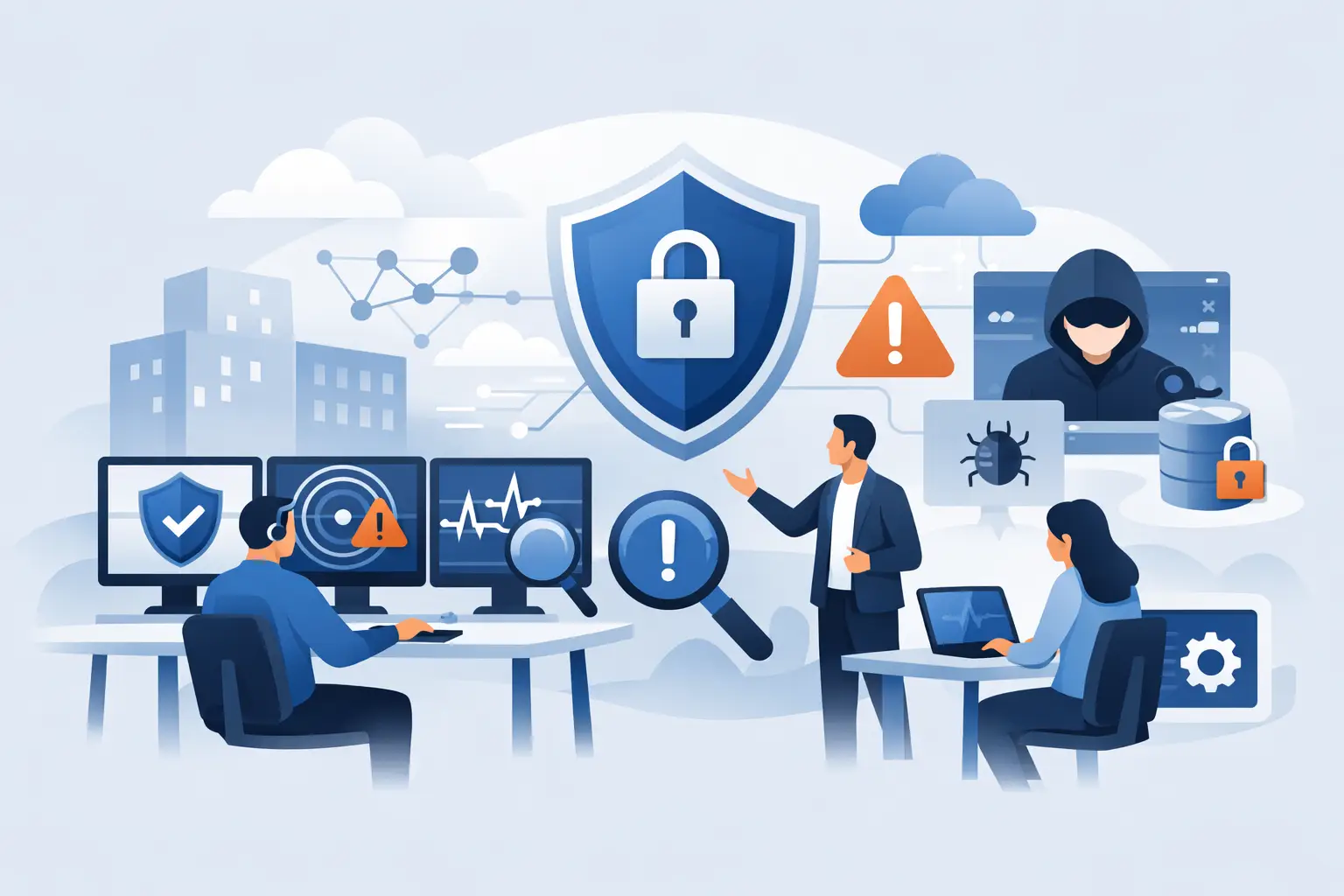
A ransomware alert at 2:13 a.m. does not care whether your internal IT team starts at 8. If nobody is watching, triaging, and containing threats when they begin, the gap between detection and action becomes the real business risk. That is why a managed detection response guide matters for organizations that need security coverage without building a full in-house security operations center.
Managed detection and response, usually shortened to MDR, is a service that combines security monitoring, threat detection, investigation, and active response. It is not just software. It is people, process, and technology working together to identify real threats and act before they become business interruptions, compliance events, or public incidents.
What a managed detection response guide should clarify
Many buyers come to MDR after a frustrating pattern. They have endpoint protection, firewalls, cloud apps, maybe even a SIEM, but alerts keep piling up and nobody has enough time or specialized skill to validate them. The problem is rarely a total lack of tools. The problem is a lack of continuous analysis, disciplined response, and accountability.
A useful managed detection response guide should cut through that confusion. MDR is designed to provide 24/7 monitoring, threat hunting, alert triage, incident investigation, and response support or direct containment, depending on the provider’s operating model. The core value is simple: fewer blind spots, faster action, and a security function that does not go offline when your staff does.
For small to mid-sized businesses, regulated organizations, and operationally complex environments, that matters because attackers do not respect office hours, staffing limits, or budget constraints. They look for weak credentials, unpatched systems, exposed remote access, and distracted teams. MDR exists to close that operational gap.
How managed detection and response actually works
At a practical level, MDR begins with visibility. Security telemetry is collected from systems such as endpoints, servers, identity platforms, cloud workloads, email environments, and network controls. That data is then analyzed using a combination of detection rules, behavioral analytics, threat intelligence, and human review.
When suspicious activity appears, the service does more than generate an alert. Analysts investigate context. They look at whether a login was merely unusual or clearly malicious, whether PowerShell activity was legitimate administration or lateral movement, whether encryption behavior is normal application activity or the early stage of ransomware.
If the threat is confirmed, response begins. Depending on the service scope, that can include isolating a device, disabling a compromised account, blocking malicious indicators, escalating to your internal contacts, and guiding remediation. The best MDR models reduce time to containment, not just time to notification.
That distinction matters. Detection without response is still exposure.
What MDR covers – and what it does not
MDR is often mistaken for a replacement for every other security function. It is not. It works best as a managed layer within a broader security program.
MDR usually covers continuous monitoring, investigation, escalation, and incident response actions around the most likely and most damaging attack paths. That often includes endpoint compromise, account takeover, suspicious lateral movement, malware activity, privilege abuse, phishing-related compromise, and cloud account anomalies.
What it may not cover depends on the provider and the environment. Compliance strategy, policy development, user training, vulnerability remediation, backup administration, and broad IT operations may sit outside the MDR scope unless delivered as part of a larger managed security relationship. This is where buyers need to ask direct questions. If a provider detects a threat tied to an unpatched server, who owns the patching? If an identity compromise begins in Microsoft 365, who handles containment? If a critical workload is hosted privately, who has authority to act?
The strongest outcomes come from integrated accountability. Security events move faster when the teams handling infrastructure, hosting, endpoint protection, and incident response are aligned under one operational model.
When MDR makes sense for your organization
Not every business needs the same depth of security operations, but many need more than basic antivirus and ticket-based IT support. MDR is usually the right fit when any of the following is true: your business handles regulated data, your systems must remain available around the clock, your internal IT team is stretched thin, or leadership needs stronger evidence that risk is being actively managed.
Healthcare groups, legal practices, financial firms, education organizations, municipalities, and distributed businesses often fall into this category. They are responsible for sensitive information, they face growing phishing and ransomware pressure, and they cannot afford long gaps between threat detection and response.
MDR also makes sense when cyber tools have become fragmented. A common scenario is an organization that has purchased several security products over time but still lacks confidence. Alerts are scattered. Nobody is certain which ones matter. Reporting is inconsistent. Executive leadership hears that security is in place, but there is no clear chain of action when something serious happens. MDR brings that into a managed operating discipline.
How to evaluate an MDR provider
If you are using this managed detection response guide to compare providers, look past marketing language and focus on operating reality. Ask who monitors alerts after hours, who investigates incidents, and who is authorized to take action. Ask how quickly the team responds, what sources they monitor, and whether reporting is useful to both technical staff and executives.
You should also look for evidence of process maturity. Security claims are easy to make. Audited controls, documented procedures, and accountable service models are harder to fake. For organizations with compliance requirements or strict operational risk standards, this is not a minor detail.
Data residency can matter as much as detection quality. If your organization must maintain Canadian data sovereignty or has board-level concerns about where systems and logs reside, you need clarity on infrastructure location, access controls, and service boundaries. Security is not just about catching threats. It is also about maintaining control over sensitive data and the environments that process it.
Finally, understand whether the provider works as an overlay or as part of a broader managed service relationship. There is no single right answer. If your internal team is mature, an overlay approach may work well. If you want fewer vendors, clearer responsibility, and tighter alignment across IT and cybersecurity, an integrated model is usually stronger.
Common MDR mistakes buyers make
One mistake is treating MDR as a checkbox purchase. If leadership expects the service to eliminate all cyber risk, disappointment will follow. MDR reduces detection and response gaps. It does not remove the need for backups, access control, patching, user awareness, and governance.
Another mistake is underestimating the importance of response authority. Some providers notify but do not act unless they receive approval. That may be appropriate in some environments, especially where change control is strict. But in a fast-moving attack, too many approval steps can cost valuable time. The right model depends on your risk tolerance, internal staffing, and operational structure.
A third mistake is buying for tool coverage instead of business outcomes. More dashboards do not equal more protection. The better question is whether the service helps you contain threats faster, maintain uptime, support compliance readiness, and reduce the burden on your team.
The business case behind MDR
Security leaders often understand the technical case for MDR immediately. Executive teams usually want the operational case. That case is straightforward.
MDR helps reduce the cost of delayed response. It lowers the chance that a real threat will sit unnoticed in the environment. It gives organizations access to specialized security expertise without requiring them to hire and retain a full 24/7 SOC internally. It also improves decision-making during incidents because investigation, evidence, and escalation are structured instead of improvised.
For many businesses, this is also about accountability. When systems are critical and data exposure carries legal, financial, and reputational consequences, reactive support is not enough. You need a defined security function that is actively watching, validating, and acting.
That is where a disciplined provider stands apart. Aegisys Cloud Solutions approaches MDR as part of a security-first managed environment, built around continuous monitoring, controlled operations, and trust that is earned through verified processes, not vague assurances.
What to do next if you are considering MDR
Start by identifying your real gaps, not just your current tools. Look at after-hours coverage, alert triage capacity, endpoint visibility, cloud monitoring, and incident response readiness. Then decide where you need support, where you need direct action, and where you need tighter accountability across security and infrastructure.
A strong MDR service should leave you with fewer unknowns. You should know who is watching, what is being monitored, how incidents are escalated, and what happens when a threat is confirmed. If those answers are still unclear after a sales conversation, keep asking.
The right partner does not just help you detect trouble. They help make sure trouble does not get the last word.