


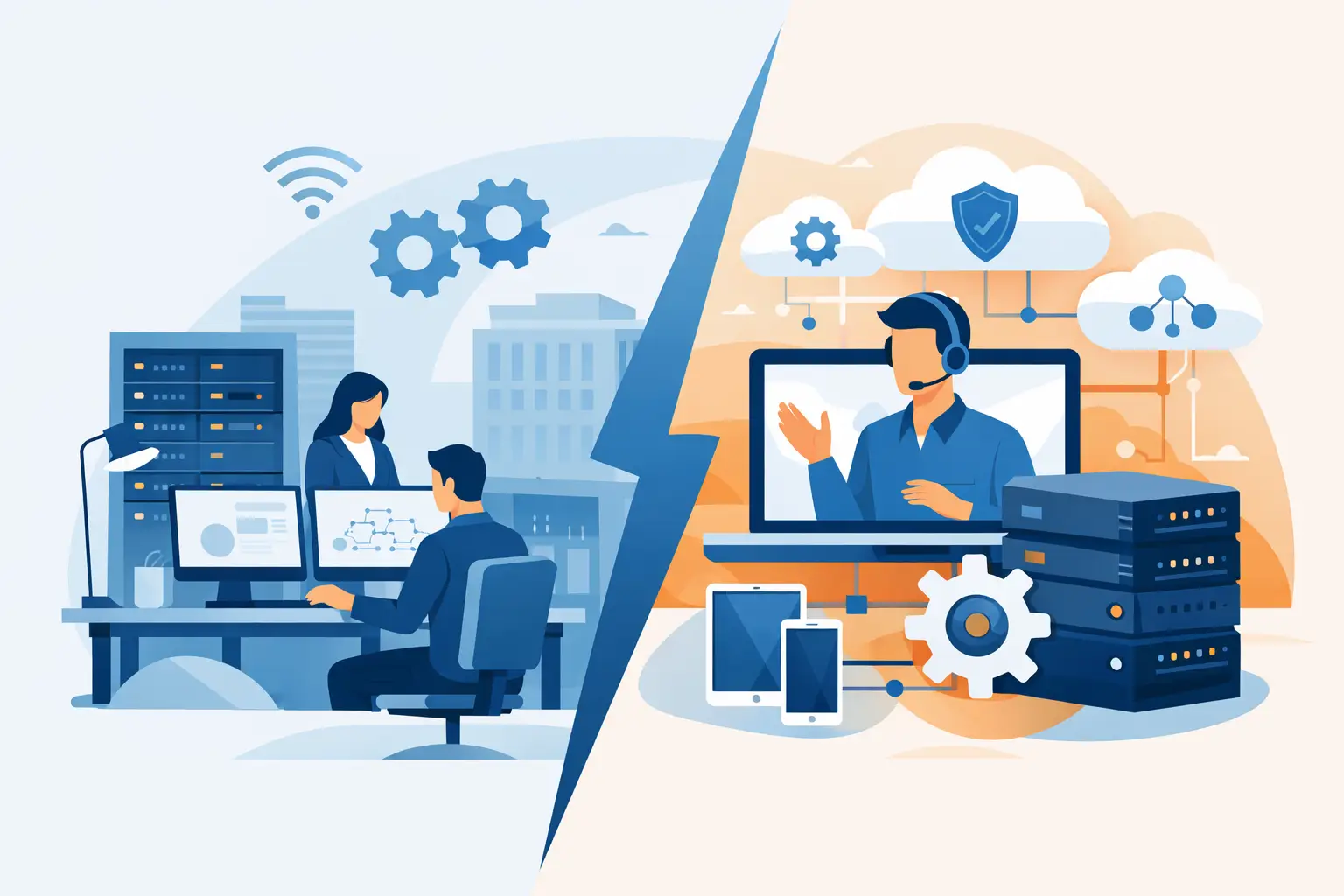
When a server fails at 2:00 a.m. or a phishing attack reaches five employees before breakfast, the real question is not who owns the IT function on paper. It is who is accountable when business operations, security, and compliance are on the line. That is why the in house IT vs managed services decision matters so much for organizations that cannot afford downtime, weak controls, or fragmented support.
For many small and mid-sized businesses, this is not a simple either-or choice. It is a risk decision, a staffing decision, and a continuity decision. The right model depends on your internal capabilities, your regulatory pressure, your growth plans, and how much operational exposure you are willing to carry.
In house IT vs managed services: the core difference
In-house IT means your organization hires employees to manage systems, users, devices, infrastructure, and often security. That can include a single IT manager, a small internal team, or a more mature department with specialists. The advantage is direct control. Your team knows your people, your workflows, and your business priorities firsthand.
Managed services means an external provider takes responsibility for defined IT functions under an ongoing service agreement. Depending on the provider, that can include help desk support, infrastructure management, cybersecurity monitoring, backup oversight, cloud operations, advisory services, and strategic planning. The advantage is breadth, process maturity, and accountable coverage that is difficult for many organizations to build internally.
On the surface, this can look like a staffing choice. In practice, it is more about whether your business needs a technician, a team, or an operating model.
Where in-house IT works well
An internal IT team can be the right fit when your business has enough scale to support specialized roles and enough complexity to justify keeping those functions close to the business. If your environment includes custom applications, deeply specific workflows, or hands-on operational systems that require daily physical presence, in-house support can offer faster context and tighter alignment.
There is also a governance benefit. Internal leaders often want direct visibility into priorities, projects, and personnel performance. In-house teams can sit in strategy meetings, respond to department-level needs, and adapt quickly to internal politics or shifting executive direction.
But this model only works well when the team is large enough and experienced enough to cover the real scope of modern IT. That scope now includes endpoint management, identity controls, patching, backup validation, cloud administration, vendor management, incident response, user support, compliance documentation, and 24/7 security awareness. One or two generalists can keep things running for a while. They usually cannot do all of that at a consistently high level.
That is where in-house IT often becomes fragile. It depends heavily on specific people. When one key employee leaves, takes vacation, or gets pulled into a major issue, coverage gaps appear quickly.
Where managed services creates leverage
Managed services gives businesses access to a wider bench of skills without the burden of hiring every role internally. Instead of relying on one person to handle networking, security, cloud, procurement, backups, and end-user issues, you gain structured support across those functions.
This matters most in environments where uptime and protection are non-negotiable. A managed services model can deliver continuous monitoring, documented processes, escalations, and service accountability that are hard to maintain with limited internal staff. For regulated organizations, that operational maturity is often more valuable than raw headcount.
A strong provider also changes the rhythm of IT. Instead of waiting for something to break, the relationship should focus on prevention, governance, and measurable control. Systems are monitored, patches are tracked, risks are reviewed, and strategic planning is not left for the annual budget meeting.
That said, not all managed service relationships are equal. If the provider is only acting as a remote help desk, the business may still be carrying major risk. Managed services is most effective when security, infrastructure, support, and advisory leadership are integrated rather than scattered across separate vendors.
Security is where the gap becomes obvious
For many organizations, the biggest weakness in an in-house model is not technical talent. It is coverage. Cybersecurity does not operate on business hours, and threats do not wait for your internal team to become available.
An internal IT manager may be excellent at supporting users and maintaining infrastructure, but that does not automatically mean they can run a mature detection and response function, monitor alerts around the clock, or manage layered controls across cloud, endpoints, identity, and backups. Security today requires process, tooling, and sustained attention.
This is one of the clearest advantages in the in house IT vs managed services discussion. Managed services providers that are built around security-first operations can apply continuous monitoring, standard response procedures, and hardened configurations across the environment. That does not remove all risk, but it reduces the chances that obvious gaps remain invisible for months.
For compliance-conscious businesses, this is not just a technical issue. It is a governance issue. Boards, executives, and auditors increasingly expect evidence that systems are monitored, access is controlled, and incidents can be contained. Security has to be operationalized, not assumed.
Compliance and accountability are often the deciding factors
Businesses in healthcare, legal, finance, education, government-adjacent sectors, and critical operations face a higher bar. They need documented controls, dependable backups, access discipline, and support that can stand up to scrutiny. In those cases, a thin in-house team may know the environment well but still struggle to maintain the documentation, consistency, and separation of duties that auditors and regulators expect.
Managed services can bring stronger accountability if the provider is disciplined, audited, and structured around clear service ownership. That is especially valuable when your business needs one accountable partner rather than a chain of vendors blaming one another during an outage or security event.
Still, outsourced accountability only works if responsibility is clearly defined. Leadership should know exactly who owns endpoint standards, backup testing, cloud changes, security monitoring, procurement guidance, and escalation paths. If those boundaries are vague, the model will underperform no matter who is involved.
The hidden cost of control
Some leaders favor in-house IT because it feels more controllable. That instinct is understandable. Internal staff are visible, available, and fully dedicated to the company. But control can be expensive when it requires hiring around the clock coverage, retaining specialized skill sets, funding training, and carrying key-person risk.
There is also a false sense of security that can come with familiarity. Just because your internal team has been with you for years does not mean your environment is well-defended or strategically aligned. Familiarity helps with service. It does not replace process discipline.
Managed services reduces some of that burden by converting operational complexity into a managed function. The trade-off is that leaders must choose a provider carefully and treat the relationship as strategic, not transactional. The best outcomes happen when the provider is trusted to enforce standards, identify risk, and guide decisions, not just reset passwords.
A hybrid model is often the smartest answer
Many businesses do not need to choose one side completely. They need the right division of responsibility.
A hybrid model works well when an internal leader owns business alignment, internal coordination, and executive communication, while a managed services partner handles the operational engine behind support, cybersecurity, monitoring, and infrastructure discipline. This approach keeps business context inside the organization while adding the scale and resilience of a broader technical team.
For growing companies, that can be the most practical path. It avoids overloading internal staff while keeping leadership close to priorities and planning. It also creates continuity when internal personnel change, which is a major advantage in environments where turnover or growth can destabilize IT operations.
Aegisys Cloud Solutions is built around this kind of security-first accountability – combining managed IT, cyber defense, hosting, and advisory support under one operational model for organizations that need control without carrying every burden internally.
How to decide which model fits your business
Start with your risk profile, not your org chart. If your operations can tolerate downtime, minimal compliance pressure, and reactive support, a small in-house team may be enough for now. If your business depends on constant availability, secure data handling, audit readiness, and fast incident response, the bar is higher.
Then look at coverage. Ask whether your current team can realistically manage user support, infrastructure, cloud, backup recovery, vendor coordination, and security monitoring without burnout or blind spots. Most importantly, ask what happens when your lead IT person is unavailable. If that answer is uncomfortable, you already have part of your decision.
Finally, consider accountability. Technology problems rarely stay technical. They become client service problems, legal problems, revenue problems, and trust problems. The right support model is the one that makes ownership clear before something goes wrong.
The strongest IT strategy is not the one that looks self-sufficient. It is the one that keeps your business protected, available, and prepared when pressure hits.