



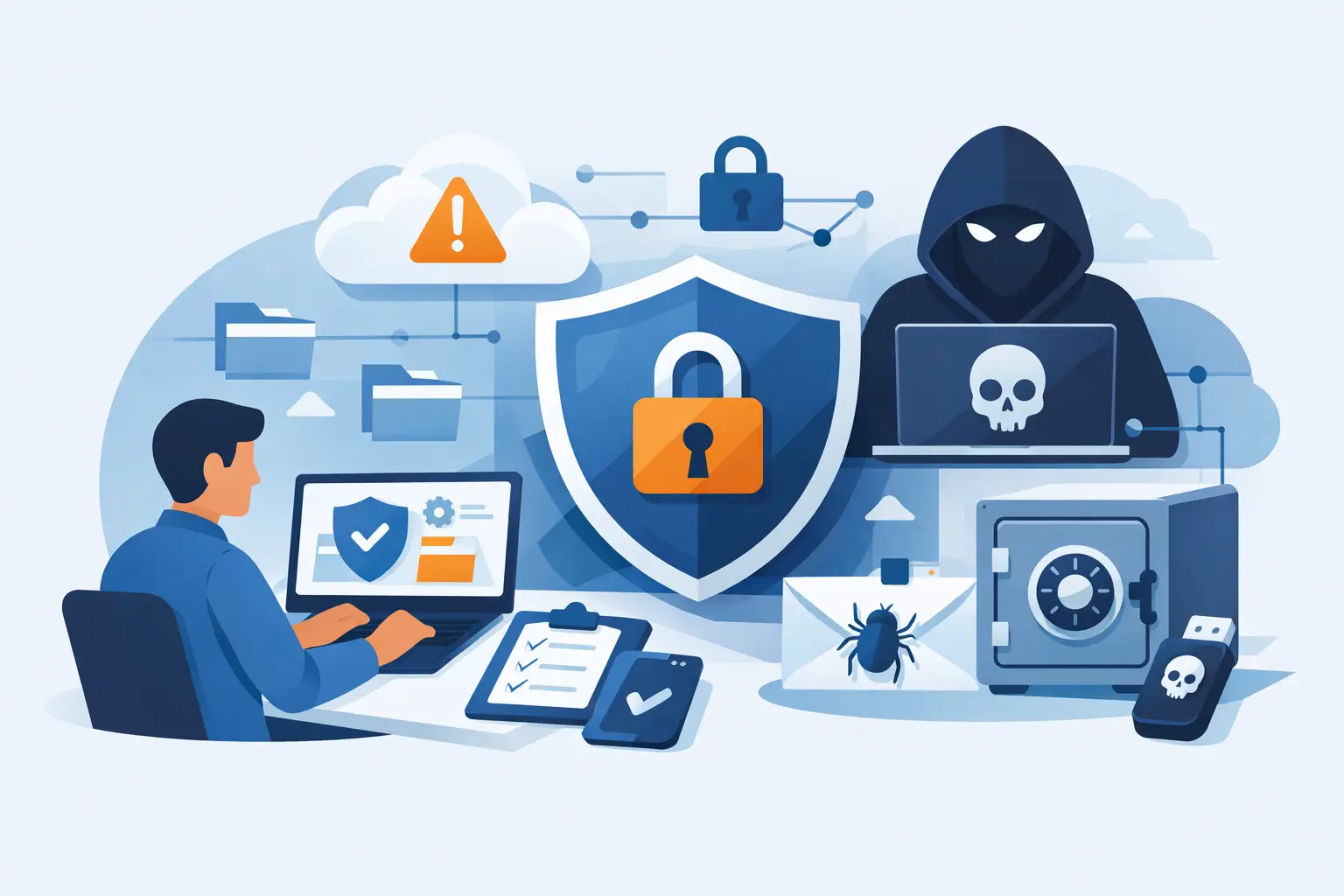
Ransomware rarely starts with a dramatic breach. More often, it begins with a single missed patch, a reused password, an employee under pressure, or an endpoint that no one is actively watching. By the time systems are encrypted, the real failure has already happened: the business was not prepared. If you want to know how to prepare for ransomware attack scenarios, the right place to start is not panic response. It is operational discipline.
For most small and mid-sized organizations, ransomware is not only a cybersecurity issue. It is a business continuity issue, a compliance issue, and often a leadership issue. The organizations that recover fastest are usually not the ones with the largest IT budgets. They are the ones that made clear decisions in advance about protection, accountability, recovery, and communication.
How to prepare for ransomware attack before it starts
Preparation begins with accepting a hard truth: prevention matters, but prevention alone is not enough. A determined attacker only needs one workable path in. Your job is to reduce the attack surface, detect suspicious behavior early, and make recovery controlled rather than chaotic.
That means looking beyond antivirus and basic firewall settings. A ransomware-ready environment includes hardened endpoints, monitored identities, tested backups, restricted privileges, and a documented response process. If one of those pieces is weak, the rest of the plan starts to bend under pressure.
A useful first step is to identify which systems would hurt the business most if they went offline for 24, 48, or 72 hours. In many organizations, the answer is not every server and every application. It is a smaller group of critical assets such as file shares, line-of-business systems, cloud productivity platforms, email, finance applications, and customer records. Once those assets are identified, you can prioritize controls around them instead of spreading effort too thin.
Build recovery around backups, not assumptions
Backups are still the dividing line between disruption and disaster, but only when they are designed for ransomware conditions. Many businesses believe they are protected because backups exist somewhere in the environment. That confidence disappears quickly if backup systems are connected to the same compromised credentials, stored on reachable network shares, or never tested under real recovery timelines.
Effective backup strategy needs separation. At least one copy should be isolated from the production environment so attackers cannot encrypt or delete it using the same access path. Retention also matters. If ransomware sits undetected for days or weeks, the newest backup may already contain corrupted or encrypted data. Recovery points should give you options.
Testing is where many plans fail. A backup is not a recovery strategy unless you know how long restoration takes, which dependencies must come back first, and whether the recovered systems actually function. For regulated organizations, this also affects audit readiness. You are not simply proving data exists. You are proving the business can restore operations in a controlled and accountable way.
Reduce the paths attackers use most
Ransomware groups tend to rely on familiar openings because familiar openings work. Phishing, exposed remote access, weak passwords, unpatched systems, and excessive permissions remain common entry points. That is good news in one sense. The basics still matter, and tightening them closes a surprising amount of risk.
Multi-factor authentication should be enforced wherever it can be, especially for email, remote access, administrative accounts, and cloud platforms. Password policy should be paired with identity monitoring, because strong passwords help less when credentials are already stolen. Remote access tools need close review. If a service is exposed to the internet, it should exist for a clear reason, be actively monitored, and be protected with more than convenience-based defaults.
Patch management is another area where leadership often underestimates exposure. Deferred updates are not only a technical backlog. They are an open invitation to threat actors who already know which vulnerabilities are easiest to exploit. That said, patching always involves trade-offs. In operational environments, healthcare settings, or legacy application stacks, immediate updates may not be possible across every system. In those cases, compensating controls such as network segmentation, restricted access, and additional monitoring become essential.
Least-privilege access deserves the same attention. Most employees do not need broad access to shared data, and most IT accounts do not need standing administrative rights for everyday work. If ransomware lands on one endpoint, limited permissions can mean the difference between a contained incident and environment-wide encryption.
Detection speed matters more than most teams think
One of the most expensive assumptions in cybersecurity is believing you will notice ransomware the moment it appears. In reality, attackers often spend time inside the environment first. They map systems, elevate privileges, disable protections, and locate backup repositories before the encryption event begins.
That is why logging, alerting, and active monitoring are not optional for serious ransomware preparation. Businesses need visibility into endpoint behavior, identity activity, suspicious file changes, and administrative actions. A login from an unusual geography, mass file access after hours, or a disabled security control may be the first signal that something is wrong.
The challenge for many internal teams is not collecting alerts. It is sorting legitimate signals from noise and responding fast enough to matter. This is where 24/7 monitoring and managed detection can materially change outcomes. Speed compresses attacker opportunity. Even a few hours can determine whether an event stays limited to one user account or spreads across core systems.
Your incident response plan should be practical, not theoretical
If ransomware hits, the first few decisions carry outsized consequences. Who isolates affected systems? Who approves shutdowns? Who engages outside counsel, cyber insurance, or forensic support? Who communicates with staff, customers, regulators, or leadership? If those answers are being figured out in real time, the organization is already behind.
A workable incident response plan does not need to be long. It needs to be clear. Roles should be assigned in advance, and contact information should be available even if normal systems are down. The plan should define escalation thresholds, containment actions, evidence preservation steps, and communication workflows. It should also account for the possibility that email, shared drives, and collaboration tools may be unavailable during the incident.
Tabletop exercises are one of the most effective ways to pressure-test this plan. They expose assumptions, handoff problems, and decision gaps before a real attacker does. They also help leadership understand that ransomware response is not solely an IT function. Operations, legal, compliance, HR, and executive leadership all have a role.
Train people for real risk, not checkbox awareness
Security awareness training often fails because it is treated like an annual formality. Ransomware preparation requires something more specific: employees need to recognize the behaviors and situations that actually lead to compromise.
That includes suspicious invoice requests, fake file-sharing notices, urgent credential prompts, unusual MFA requests, and unexpected messages from executives or vendors. Training should reflect the organization’s actual tools and workflows so employees can spot what looks wrong in context. A generic slideshow once a year will not meaningfully reduce phishing risk.
There is also a cultural element. Staff should feel safe escalating a suspicious email or admitting they clicked something questionable. A blame-heavy culture delays reporting, and delayed reporting gives attackers time. Fast escalation often prevents a minor event from becoming a major one.
Align ransomware preparation with business continuity
The strongest ransomware plans are built around business priorities, not just technical controls. That means defining recovery objectives for critical systems, documenting manual workarounds where possible, and understanding which vendors or partners are operational dependencies.
For example, if your ERP platform is unavailable, can finance still process payroll? If your document management system is encrypted, can legal or healthcare teams continue essential work for even one day? If your building access or surveillance platform is integrated with IT systems, what happens to physical security during an outage? These are not edge cases. They are continuity questions that determine whether an incident remains manageable.
This is where a security-first managed environment can provide an advantage. When infrastructure, endpoint management, monitoring, backup oversight, and strategic planning are handled as one accountable program, there are fewer blind spots between tools and teams. At Aegisys Cloud Solutions, that kind of integrated responsibility is central to how ransomware resilience is built.
How to prepare for ransomware attack with executive ownership
Ransomware resilience improves when leadership treats it as a governance issue rather than a technical nuisance. Executives do not need to run security tools, but they do need to set priorities, fund critical controls, approve response structure, and require regular testing. They also need honest reporting. A green dashboard that hides weak backup integrity, incomplete MFA coverage, or inconsistent patching is not risk management. It is wishful thinking.
A better approach is disciplined and measurable. Know your critical assets. Confirm backup recoverability. Reduce administrative sprawl. Monitor continuously. Rehearse incident response. Train employees with realistic scenarios. Review the plan when infrastructure, staffing, or compliance obligations change.
No organization can guarantee it will never face ransomware. What it can do is make itself harder to compromise, faster to detect, and far more capable of recovery. That is what preparation should accomplish: not false certainty, but controlled resilience when the pressure is real.